
An Operational Strategy to Eliminate Network Blind Spots, Accelerate Inventory Audits, and Build a Frictionless Ground-Floor Tech Spine.
In high-volume retail management, square footage is a double-edged sword. When you scale past a 10,000 sq ft footprint, a floor layout is no longer just a physical space—it is a data grid. Every pallet movement, inventory audit, and checkout transaction relies on an invisible flow of real-time data.
Having spent over 15 years optimizing raw store fields, I have seen firsthand how standard, consumer-grade tech crumbles under industrial scale. A dropped Wi-Fi signal in aisle 12 isn't just a minor glitch; it is an operational bottleneck that stalls stock teams, delays data modeling, and compromises profit margins.
To scale predictably and protect your backend operations, you need specialized, enterprise-grade hardware built for endurance and speed. Here is the field-tested infrastructure required to turn a massive storefront into a highly efficient command center.
1. The Network Spine: High-Capacity Enterprise Mesh Wi-Fi
A massive commercial layout creates severe wireless dead zones. Metal warehouse shelving, high inventory density, and sheer distance actively block standard routers, causing handheld stock terminals to lag. To maintain data continuity across thousands of square feet, an enterprise-grade mesh network with dedicated backhaul intelligence is essential.
The Operational Advantage: Provides a seamless wireless blanket that handles up to 200 devices simultaneously. Floor supervisors can move from the loading bay to the front counter without experiencing a single micro-second of database disconnection.
My Top Recommendations (Click product name to check & buy 👇):
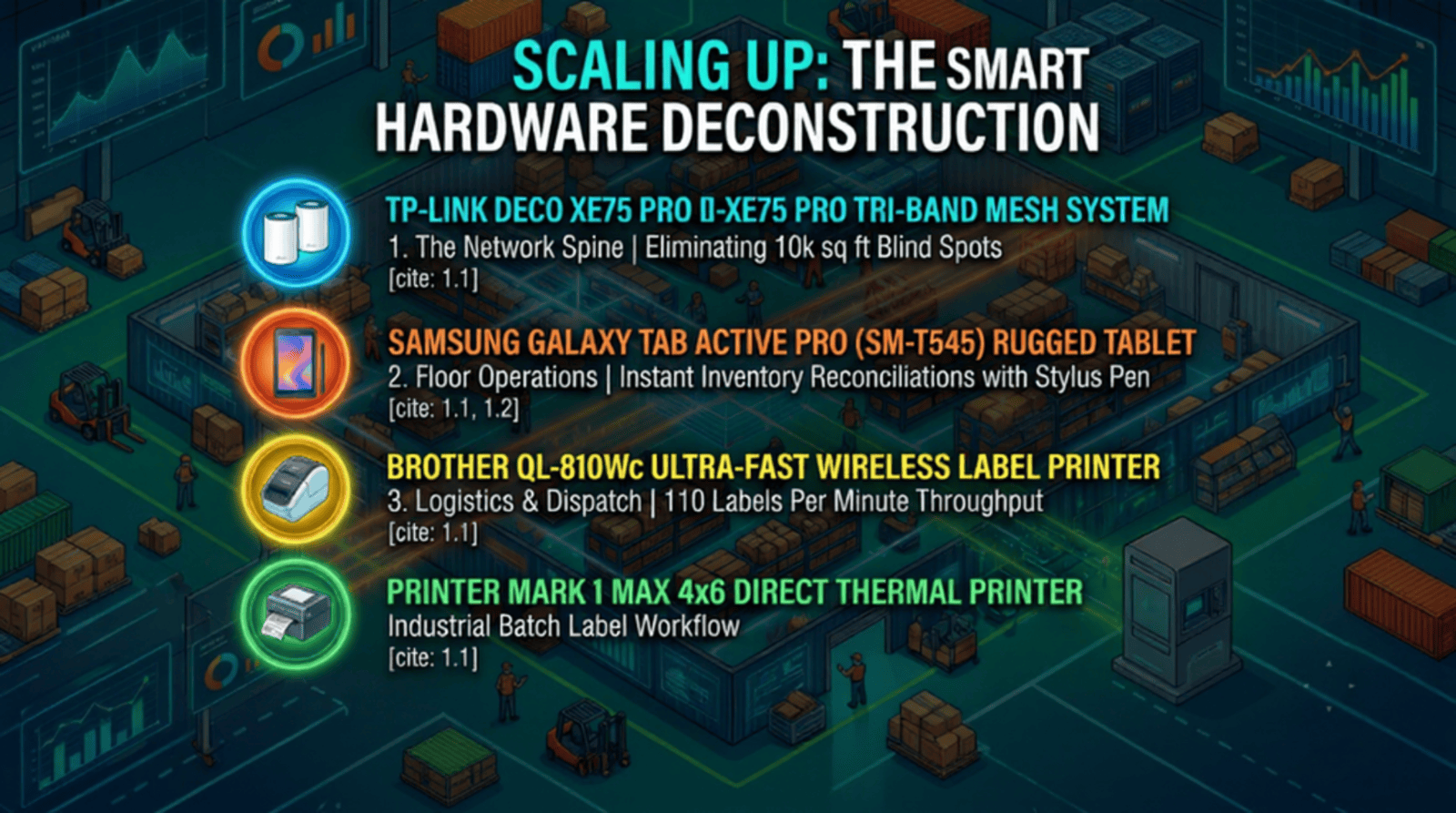
TP-Link Deco XE75 Pro AXE5400 Tri-Band Mesh System– The ultimate network spine featuring a dedicated 6 GHz backhaul to eliminate dead zones across massive commercial properties.TP-Link Deco BE25 Next-Gen Wi-Fi 7 System– Cutting-edge dual-band technology designed to minimize network latency and accelerate real-time multi-device asset tracking.
2. Floor Operations: Military-Grade Rugged Industrial Tablets
Standard mobile tablets are a liability on a busy warehouse or retail floor. They cannot survive a drop from a forklift, they lack industrial data durability, and their consumer batteries decay during long shifts. True field execution requires rugged enterprise terminals that blend processing muscle with heavy-duty physical protection.
The Operational Advantage: Accelerates high-volume inventory reconciliation. These units feature ultra-tough screens that can be operated easily with fingers or an accurate stylus pen, keeping inventory updates instant even in demanding low-light warehouse conditions.
My Top Recommendations (Click product name to check & buy 👇):
Samsung Galaxy Tab Active Pro 10.1" Rugged Tablet (SM-T545)– A battle-tested, MIL-STD-810G certified workhorse featuring native LTE connectivity, IP68 water resistance, and an accurate, glove-friendly S Pen workflow.Higolepc IP67 Waterproof Windows 11 Pro Rugged Tablet– A heavy-duty, dustproof mobile terminal backed by a massive 16,000mAh battery to sustain 10-hour auditing shifts.
3. Logistics and Dispatch: High-Speed Direct Thermal Label Printers
High-volume store inventory scaling demands rapid, smudge-free tag printing. Fumbling with standard desktop ink cartridges during a massive stock ingestion block is highly inefficient. Direct thermal printers use heat-sensitive media to print labels instantly, eliminating ink maintenance costs entirely.
The Operational Advantage: Maximizes warehouse dispatch throughput. Enables operations teams to execute flawless batch prints for packaging, shipping barcodes, and storage bin labels directly over the local network.
My Top Recommendations (Click product name to check & buy 👇):
Brother QL-810Wc Ultra-Fast Wireless Label Printer– A high-speed professional thermal unit printing up to 110 labels per minute with seamless Wi-Fi connectivity.PrintInc Mark 1 Max 4x6 Direct Thermal Printer– An industrial, high-velocity workhorse engineered to handle thousands of high-contrast logistics labels with zero maintenance overhead.
Conclusion
Upgrading your ground-floor infrastructure is not about chasing flashy technology; it is about protecting your operational margins. When your enterprise hardware eliminates network drops and scanning friction, your floor teams move faster, your inventory data stays pure, and your business remains completely positioned to scale.
Want to implement the exact backend tools that track these metrics? Explore my field-tested retail audit checklists and daily sales trackers natively on Vyas Insights.