
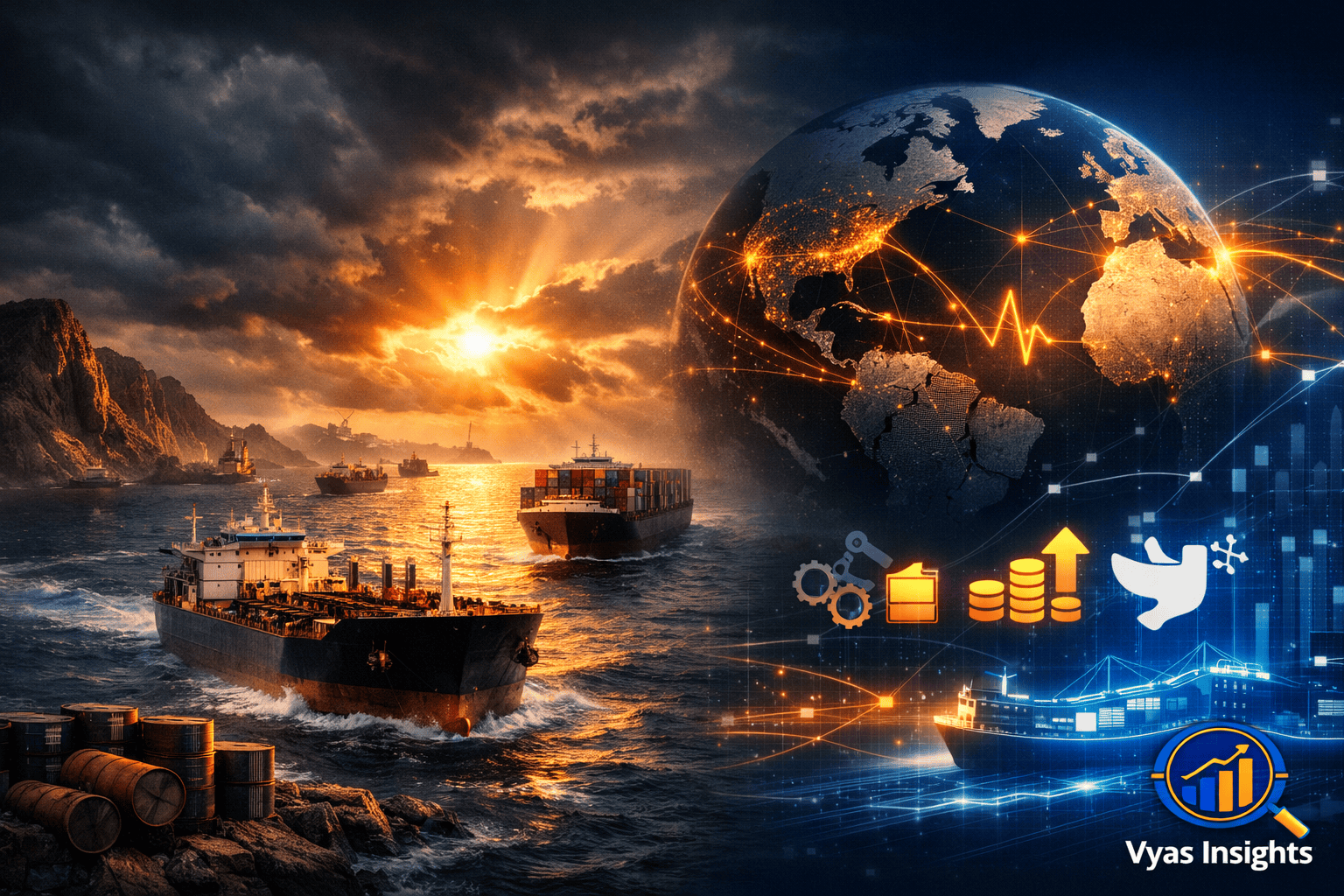
The Structural Breakdown: How a Regional Conflict Evolved Into the Century's Greatest Energy and Supply Chain Crisis.
The Strait of Hormuz has always been more than a narrow waterway. It is the artery through which nearly 20% of the world’s oil and LNG flows. Today, as tensions rise once again across the Gulf, the world is reminded that when Hormuz falters, humanity feels the shockwaves.
The Strait of Hormuz has always been more than a narrow waterway. It is the artery through which nearly 20% of the world’s oil and LNG flows. Today, as tensions rise once again across the Gulf, the world is reminded that when Hormuz falters, humanity feels the shockwaves and the world is discovering a painful, systemic lesson: when a microscopic maritime corridor in the Gulf fractures, the entire global ecosystem bleeds. For years, international trade was discussed in smooth abstractions—globalization, seamless supply chains, and borderless digital transactions. But the escalating 2026 geopolitical crisis in the Strait of Hormuz has shattered those illusions. What began as localized geopolitical instability has rapidly metastasized into the largest disruption to the world energy and logistical market since the 1970s.
Yet, beneath the sterile graphs of soaring Brent Crude prices and skyrocketing marine war-risk insurance premiums lies a starker, far more urgent crisis: a devastating toll on human life, regional food security, and global stability. It is time to look past the corporate spreadsheets and examine the true cost of the chokepoint.
🗺️ Beyond the Chokepoint: The Global Reordering and Asymmetric Losses
To understand the sheer magnitude of what the world has lost, we must look at the structural reordering that has occurred since the blockade effectively froze the strait on March 4, 2026.
The global distribution network relies on this single node to move approximately 20% of global oil supplies and one-fifth of liquefied natural gas (LNG). The sudden halt has stranded millions of barrels of production per day, triggering a multi-commodity contagion across commodity and financial markets worldwide
.
💔The Critical National Impacts: Who Lost the Most?
The Gulf Cooperation Council (GCC) States: The traditional economic model of the Gulf states has faced a systemic challenge. With energy and LNG exports stranded, the blockade triggered an immediate "grocery supply emergency." Because these nations rely on the strait for over 80% of their food intake, the disruption immediately compromised regional food security, forcing massive, expensive logistical airlifts just to keep grocery staples on the shelves.
Europe and the Western Sphere: Europe was hit by a secondary energy-supply shock. Coinciding with historically low winter gas reserves, the suspension of Qatari LNG sent energy costs soaring, forcing central banks to halt planned interest rate reductions and driving energy-intensive industries to the brink of technical recession.
Asian Super-Importers: Major consumers like India, Japan, and South Korea—who historically drive 75% of Gulf oil demand—have had to urgently scramble for alternative, far longer trade routes around the Cape of Good Hope, inflating logistics costs exponentially. Disruptions have driven oil prices above $90–100 per barrel, sparking inflation across food and transport.
Human security: Families in Asia, Africa, and Europe face rising costs of essentials, proving that energy security is human security.
⚖️ Who Gained the Most?
Alternative Trade Corridors & Non-Gulf Energy Producers: Domestic energy markets less exposed to the Persian Gulf have seen a sharp rise in pricing power. Strategically, continental land routes—like the Central Asian Middle Corridor—have suddenly gained immense traction as international stakeholders desperately seek ways to bypass maritime chokepoints entirely.
U.S. shale producers: Benefiting from higher export margins.
Russia: Narrowed sanctions discounts, boosting GDP by 6–11%.
Saudi Arabia & UAE: Partial bypass pipelines to the Red Sea and Fujairah provide limited relief (~5.5 mb/d vs. 20 mb/d through Hormuz).
🔮 The Road Ahead: Future Pros and Cons of a Fragmented Order
As multinational enterprises attempt to redraw the business map, this ongoing crisis presents a stark set of structural shifts:
The Cons: Fragility and Stagflation
The immediate future points toward a volatile, fractured global economy. Persistent disruptions in fuel and fertilizer markets threaten long-term global food prices. For businesses, transit times are no longer the primary concern—capacity pressure, emergency freight surcharges, and massive documentation risks are the new baseline realities.
The Pros: The Forced Evolution of Resilience
If there is a strategic silver lining, it is the death of complacency. This crisis is aggressively forcing the logistics industry to diversify. Governments and shipping corporations are now investing heavily in structural resilience: near-shoring, multi-modal trade corridors, and domestic alternative energy grids that insulate economies from localized geopolitical shocks.
🕊️ The Humanitarian Imperative: A Request to Save Human Lives
Yet, as strategists analyze trade routes and rerouted tankers, we must never lose sight of the most tragic inventory: the human cost.
Since late February, merchant shipping vessels have been targeted, set ablaze, or abandoned. Innocent seafarers and port workers have lost their lives or been critically wounded in these waters. These are not military combatants; they are standard crew members, logistics workers, and sailors simply fulfilling their duties to keep the world fed and powered.
A fragmented global order cannot function if its most basic maritime corridors are turned into active war zones. The international community, regional powers, and global regulatory bodies must look past political posturing and unite to establish a binding global security architecture.
Protecting these lanes is no longer just about preserving global GDP multipliers or corporate margins. It is a fundamental humanitarian duty. The world must demand an immediate cessation of maritime hostility, ensure the unhindered flow of life-saving civilian goods, and protect the lives of the thousands of seafarers who keep our world moving.
How is your organizational supply chain adapting to the reordered trade routes of 2026? Let’s open up the discussion below on building resilience while keeping global stability at the forefront.
.
👉 This is a call to the world: safeguard lives, not just barrels. Diplomacy, de‑escalation, and humanitarian corridors must come before another drop of crude becomes more valuable than human life.