
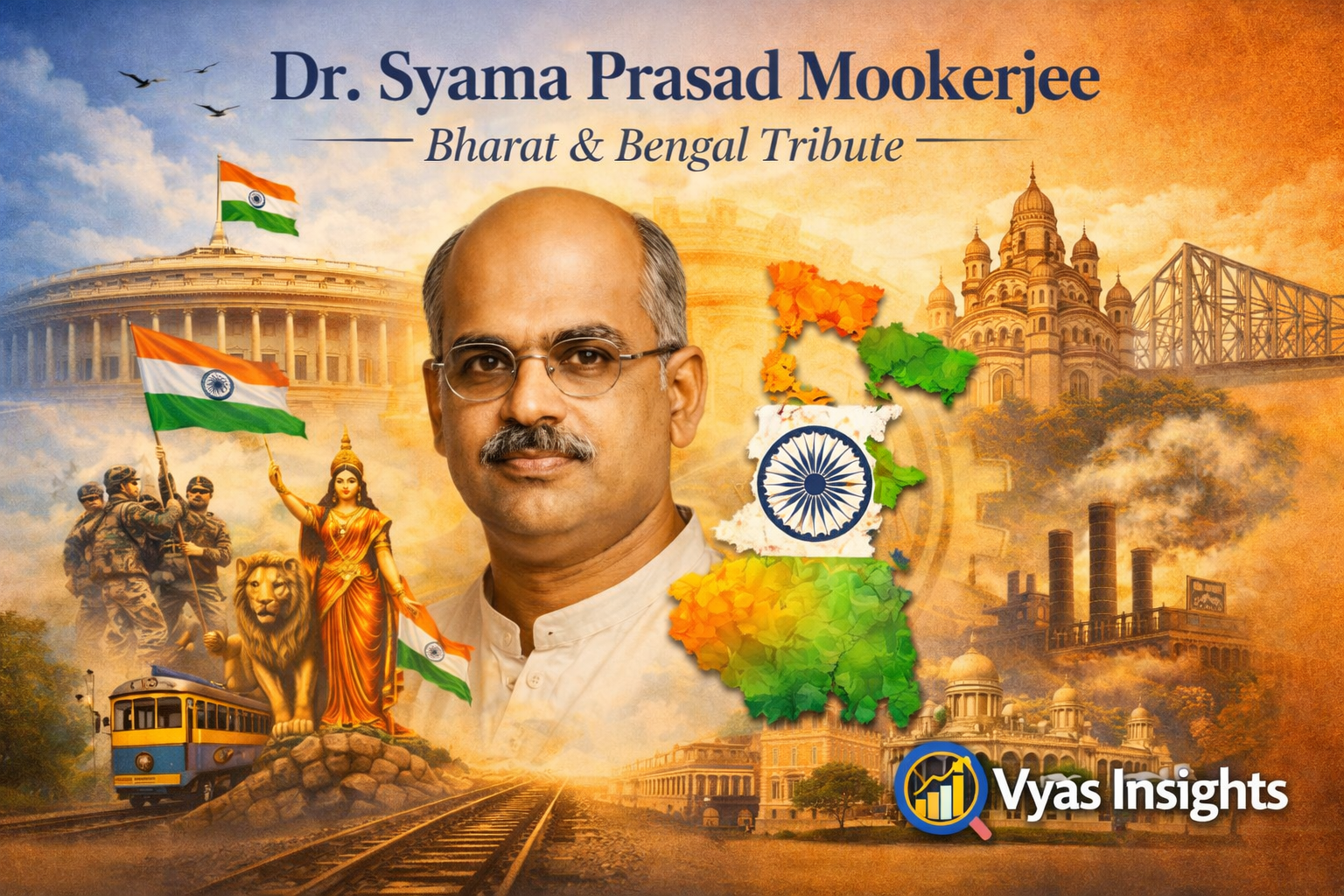
A Strategic Leader Beyond Politics
Today, July 6th, marks the 125th birth anniversary of Dr. Syama Prasad Mookerjee—a visionary statesman, a pioneering educationist, and the man who undeniably altered the geographical and political destiny of modern India.
While history often remembers him primarily as the founder of the Bharatiya Jana Sangh (the predecessor to the BJP) and a martyr for the complete integration of Jammu & Kashmir, his most consequential and often overlooked contribution was his fight to secure West Bengal for India.
As a retail operations leader who analyzes data and geopolitical supply chains, I look back at Dr. Mookerjee's legacy not just as history, but as a masterclass in strategic foresight, industrial foundation, and uncompromising national resilience.
The Savior of Bengal: Thwarting the "United Bengal" Plan
In the turbulent months leading up to the 1947 Partition, a dangerous proposal was floated by leaders like Huseyn Shaheed Suhrawardy and Sarat Chandra Bose: the creation of a "Sovereign United Bengal."
On paper, the idea of an undivided, independent Bengal separate from both India and Pakistan sounded culturally appealing. In reality, demographic data and political maneuvering meant that this entire independent state would have rapidly fallen under the absolute dominance of the Muslim League, effectively absorbing the entirety of Bengal into East Pakistan.
Dr. Mookerjee saw through the rhetoric and understood the catastrophic demographic reality. Driven by the axiom, "When faced with total ruin, wise men sacrifice half," he launched a relentless, data-driven campaign. He argued that if India was to be partitioned on religious lines, Bengal must also be partitioned to save the Hindu-majority western districts.
Through sheer political willpower and mass mobilization, Dr. Mookerjee forced the hands of the British, the Congress leadership, and the Muslim League. Without Dr. Syama Prasad Mookerjee, Kolkata (Calcutta) and the entirety of West Bengal would not be a part of India today. He gave millions of displaced refugees a homeland and ensured that Bengal's rich cultural, intellectual, and economic capital remained rooted in the Indian Union.
The Foundation of Industrial India
When India achieved independence, Mahatma Gandhi personally invited Dr. Mookerjee to join Prime Minister Jawaharlal Nehru’s first cabinet as the Minister for Industry and Supply.
At a time when India was economically fractured, Dr. Mookerjee laid down the very first infrastructural pillars of the nation’s self-reliance (the true precursor to today's Aatmanirbhar Bharat). During his short tenure, he established three of modern India's most critical industrial engines:
The Chittaranjan Locomotive Works: Ensuring India could build its own railway infrastructure.
The Sindri Fertilizer Corporation: Securing the agricultural supply chain to feed a starving nation.
Hindustan Aircraft Factory (now HAL): Laying the groundwork for India's aerospace and defense manufacturing.
He understood that true sovereignty requires robust, localized supply chains and heavy manufacturing—a reality that the world is only just waking up to in the post-pandemic era.
The Youngest Vice-Chancellor and Educational Reformer
Before entering the rough-and-tumble of politics, Dr. Mookerjee was a prodigy of academia. At the age of 33, he became the youngest Vice-Chancellor in the history of Calcutta University.
He pioneered the "democratization of education," believing that national progress was impossible if education remained a luxury for the elite. He introduced Indian languages as mediums of instruction, started the first agricultural education courses, and invited Rabindranath Tagore to deliver a convocation address in Bengali—a historic first that shattered colonial academic traditions.
Relevance to Current Bharat
Today, as India navigates complex global supply chains, aggressive border posturing, and internal debates over constitutional unity, Dr. Mookerjee’s core philosophy remains striking: "One Nation, One Constitution, One Flag."
His ultimate sacrifice in a Srinagar jail in 1953, fighting against the permit system that restricted Indians from entering Kashmir, eventually culminated in the abrogation of Article 370—a delayed but definitive fulfillment of his vision for an undivided, legally unified Bharat.
As we celebrate his 125th birth anniversary, we must remember Dr. Syama Prasad Mookerjee not just as a politician, but as a strategic architect. He saved Bengal, built India’s first factories, and laid down the ideological blueprint for the strong, self-reliant Bharat we are building today.
Building Your Own Resilient Infrastructure
Dr. Mookerjee understood that a nation’s strength lies in its systems, localized control, and robust operational blueprints. In the modern business landscape, the same principles apply. Scaling your operations and protecting your revenue requires unbreakable systems.
To help you build a self-reliant structure for your business, I have compiled my 15+ years of high-volume retail management experience into a single, actionable resource.
👉 Download the 2026 Retail SOP Toolkit Today and start sealing the revenue leaks in your operations.