
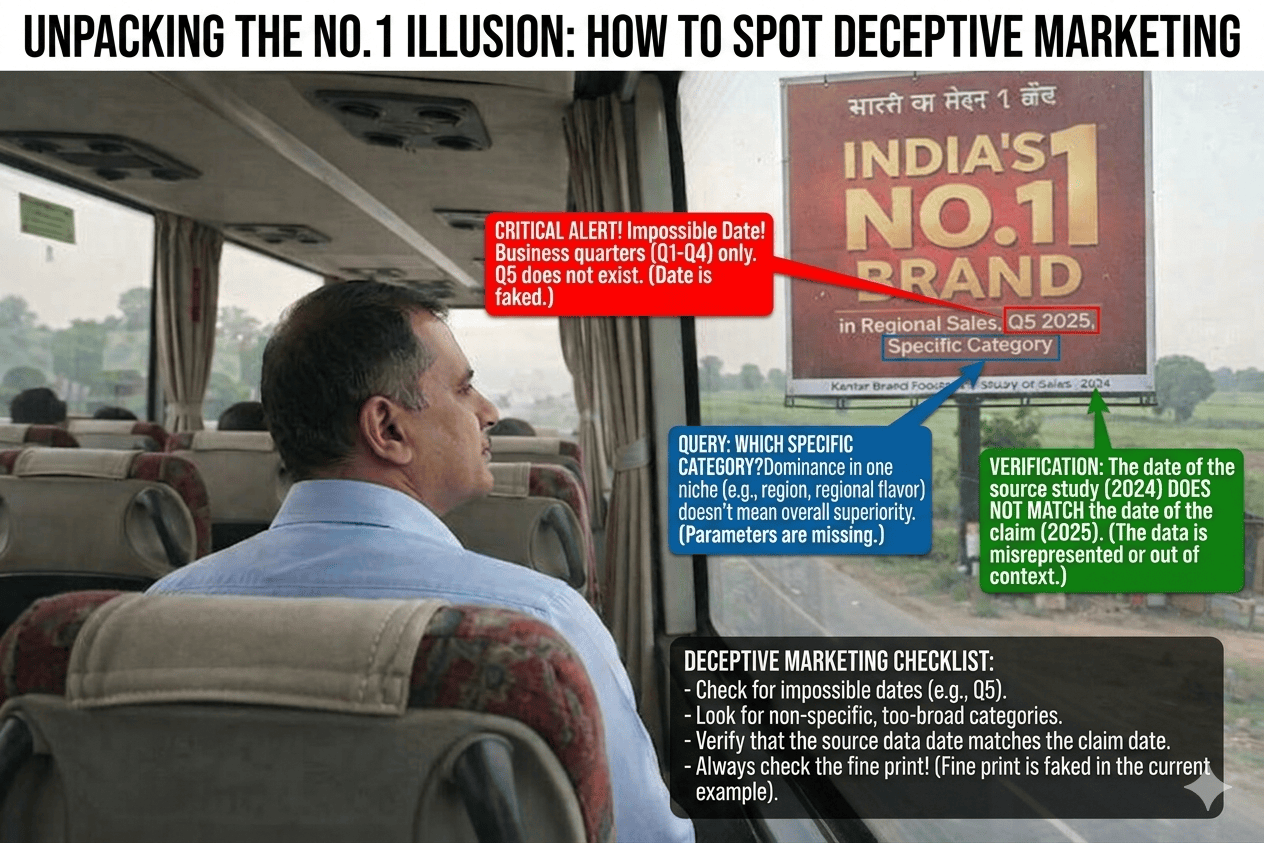
A retail insider’s guide to decoding microscopic fine print, spotting engineered marketing claims, and making smarter buying decisions.
Hi everyone. A quick word of caution for all consumers: be very careful before falling for those massive advertising claims you see on billboards.
The "No. 1" Illusion in Retail Advertising
Watching the highway billboards roll by on my way back to Prayagraj today, I couldn't help but notice a recurring theme...
We see it every day—on highway billboards, full-page newspaper spreads, and digital ads. In massive, unmissable text, a company proudly declares itself the "No. 1 Brand." It is a powerful psychological trigger that immediately builds trust.
But as someone who has spent over a decade and a half managing high-volume retail operations, I can tell you that the reality behind these claims is often heavily engineered.
The Halo Effect of a Single Category
Many large brands produce goods across multiple categories. In a highly competitive market, a company might struggle against fierce rivals in their primary product lines, but manage to secure the highest sales volume in one specific, smaller sub-category.
Instead of advertising that specific victory, the marketing department will broadcast a generalized "No. 1" claim across the entire brand. They are relying on you, the consumer, to assume that their dominance in one minor area applies to their entire catalog.
The Microscopic Truth
The Advertising Standards Council of India (ASCI) requires claims to be substantiated. To avoid legal trouble, brands must state the parameters of their "No. 1" claim.
However, they do this by placing an asterisk next to the massive headline, which directs you to terms and conditions printed in a font so small it is nearly invisible. That tiny text contains the actual truth: the specific parameter, the limited timeframe, or the narrow survey demographic where they actually hold the top spot.
How to Be a Smart Consumer
Before you let a bold advertising claim sway your purchasing decision, take a moment to investigate:
Check the Parameters: Look for the asterisk. What exactly are they leading in?
Evaluate the Specific Product: If a company makes excellent air conditioners but terrible washing machines, a broad "No. 1" brand claim doesn't mean you should buy their washing machine. Evaluate the specific product against its direct rivals.
Look for Independent Reviews: Rely on actual user feedback and independent testing rather than a brand's self-proclaimed status.
In the retail world, visibility is everything, and brands will use every trick in the book to grab your attention. It is up to us to read the fine print.