
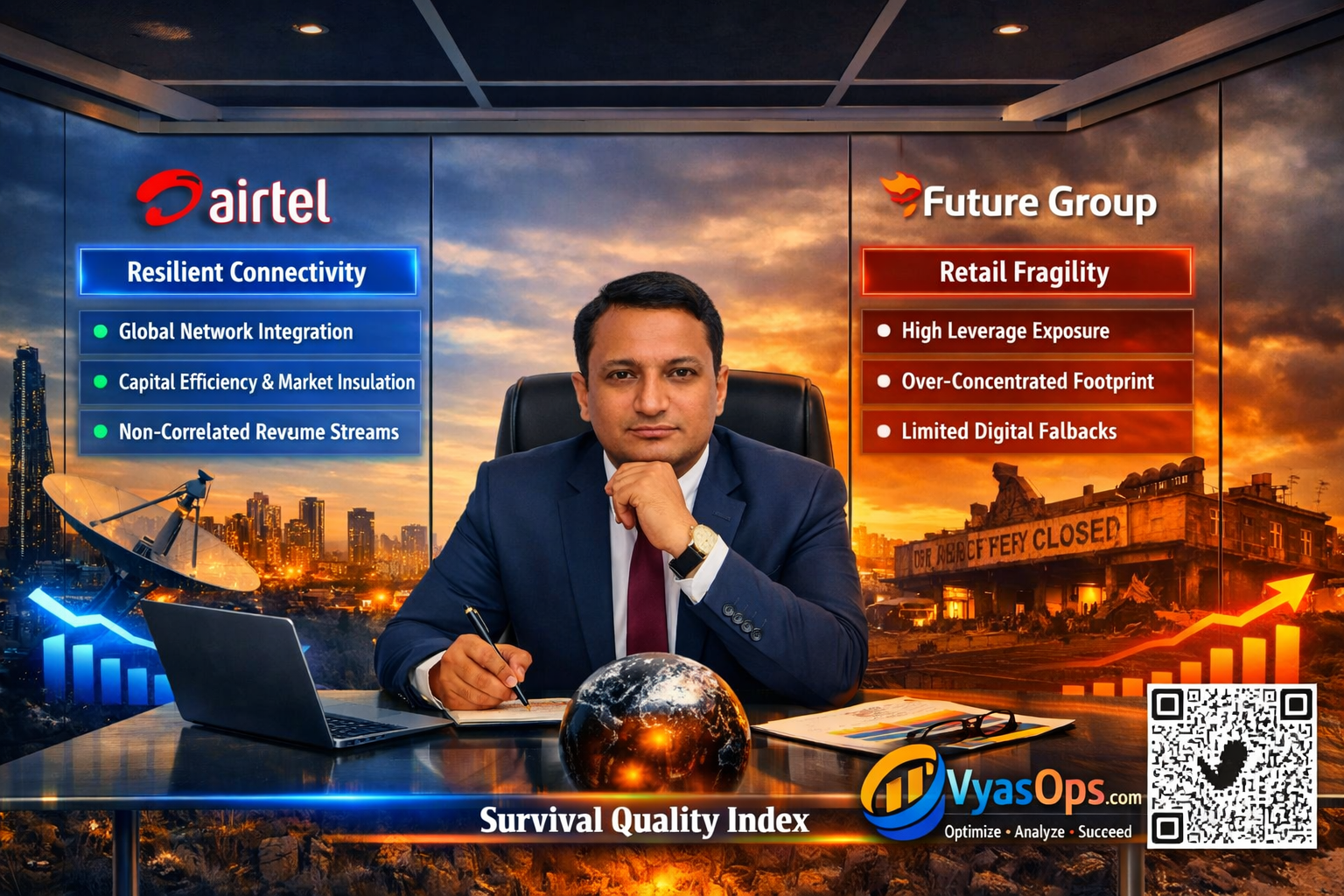
The Strategy Autopsy: How One Brand Built an Ironclad Shield While a Retail Titan Incubated a Collapse
The Strategy Autopsy: How One Brand Built an Ironclad Shield While a Retail Titan Incubated a Collapse
Introduction: One strategy saved a corporate giant. The other led to a multi-crore collapse.
As we navigate intense geopolitical conflicts, supply chain shocks, and market volatility, corporate stability has become a myth. True operational resilience isn't about hoping the storm passes—it is about actively architecting a shield so that if one engine fails, the entire business stays upright.
Looking closely at the last decade, we find two defining corporate trajectories. Both faced brutal market headwinds:
Bharti Airtel used geographic and digital diversification as an absolute operational shield.
Future Group concentrated everything on a single, high-leverage domestic engine, only to see it face a catastrophic single-point failure.
This analysis pulls back the curtain on the exact operational blueprints of survival versus structural breakdown.
diversification is no longer a luxury for corporate expansion; it is the ultimate engine of absolute survival strength.
1. The Corona Lesson: Structural Diversification vs. Total Shutdown
The global pandemic was a brutal, unyielding stress-test for single-engine businesses. However, it also highlighted the profound power of strategic adaptability.
The Vulnerability: Companies that relied entirely on a single physical footprint, a localized supply chain, or a solitary revenue stream faced an immediate, paralyzing halt.
The Survival Strength: Conversely, the organizations that survived—and ultimately thrived—were those that had quietly built multi-layered structures. Brick-and-mortar setups that quickly ignited digital distribution channels, and leaders who had already mapped out dual-sourcing options outside a single geographical territory, kept their systems running.
The Takeaway: When your primary operational environment faces a sudden, systemic barrier, your survival strength depends entirely on the alternative pathways you had the foresight to build.
2. The Anatomy of Exposure: Future Group’s Collapse vs. Bharti Airtel’s Shield
To truly understand how deep-rooted diversification translates into real-world survival strength, we must contrast two entirely different corporate trajectories: the tragic collapse of Future Group and the triumphant resilience of Bharti Airtel. One relied entirely on a concentrated, single-point engine; the other engineered a global, multi-engine lifesaver.
The Collapse of Future Group: The Danger of Over-Concentration
At its peak, Kishore Biyani’s Future Group (Big Bazaar, Food Bazaar, Central) was the undisputed pioneer of modern Indian retail. Yet, it folded under an unsustainable burden of debt and sudden operational stagnation.
The Trap of Concentration: Future Group aggressively scaled its physical footprint through heavy financial leverage, concentrating all its stakes on the domestic, brick-and-mortar consumer market. They moved forward on the assumption that domestic growth would indefinitely outrun their massive liabilities.The Single Point of Failure: When the pandemic forced immediate lockdowns, physical retail stopped completely. Because Future Group lacked a robust, diversified digital ecosystem and possessed zero international operations to generate alternative cash flow, their revenue plummeted to near zero. Meanwhile, their massive fixed liabilities—like mall rentals and compounding debt interest—remained entirely unchanged.The Hard Lesson: When their sole engine was compromised, the entire empire dissolved. It stands as a stark reminder that over-concentration in a single model can dismantle even a market leader if the wind changes direction.Bharti Airtel’s Survival: The Africa Cushion
Now, contrast that with how Sunil Bharti Mittal navigated the entry of Reliance Jio in 2016. Jio’s hyper-aggressive, free-data pricing model completely disrupted the Indian telecom sector, forcing rapid consolidation and driving multiple long-standing players into outright insolvency. Airtel faced a massive domestic storm, yet it stood firm and emerged stronger.
The Geographic Shield (Airtel Africa): When Airtel initially acquired Zain’s African operations in 2010 for $10.7 billion, industry analysts heavily criticized the move because the African sector was bleeding capital at the time. However, by 2016, Airtel Africa had transformed into a highly profitable powerhouse operating across 14 countries.Absorbing the Shockwave: When Jio struck the Indian market and domestic margins collapsed, Airtel didn't panic. Because they were strategically diversified across an entirely different continent, Airtel Africa provided a steady, non-correlated stream of revenue and cash flow.The Ultimate Triumph: Airtel effectively utilized its international diversification to absorb the domestic shockwave, stabilize its corporate balance sheet, and confidently fund its critical 4G and 5G infrastructure upgrades back home. They survived the domestic price war because they were too geographically diverse to fail.3. The Strategic Framework: Sourcing Survival Strength
Strategic Element The Over-Concentrated Model (Future Group) The Strategically Diversified Model (Bharti Airtel) Risk Distribution High concentration in one country, one format (Physical Retail). Spread widely across multiple geographies and distinct consumer sectors. Crisis Response Immediate operational paralysis when the main market was disrupted. Absorbed a fierce domestic price war using reliable international revenue. Financial Security Debt-heavy expansion with zero alternative fallback channels. Utilized secondary market cash flows to sustain and win primary market battles. Core Outcome Insolvency & Asset Liquidation Market Leadership & Unshakable Stability 4. Looking Forward with Hope: Standing Courageously in 2026
Today, in May 2026, the global corporate ecosystem faces complex geopolitical frictions, changing trade alliances, and shifting tech landscapes. It is easy for businesses to look at these conditions with anxiety—but our past gives us every reason to be full of hope.
The corporate victories of the last decade show us exactly how to navigate today's terrain. True operational courage isn’t about blindly hoping the storm will avoid you; it is about standing firm and actively building a multi-layered defensive strategy:
Geographic & Digital Resilience: Cultivating independent revenue lines, specialized consulting models, or digital assets that run parallel to your primary business operations.Supply Chain Agility: Actively moving away from single-source dependencies toward regional partnerships ("friend-shoring") to keep inventory and logistics completely secure.Tech Sovereignty: Protecting vital data frameworks across decentralized, highly secure cloud environments to stay entirely insulated from regional geopolitical policy changes.Conclusion: Built to Endure
We choose to stand firm because history proves that those who diversify their foundations are built to endure. By learning directly from the corporate battles of yesterday, we gain the precise tactical clarity needed to face tomorrow.
Analyze your risks, diversify your channels, and step forward with absolute confidence. When you build a business model with multiple pillars, no single storm can ever take your roof down.